Updated: March 2026 | Flooring & Interior Surface Specialist
We have been specifying and installing luxury vinyl plank flooring for well over a decade, and the product we are working with today barely resembles what was available in 2014. Back then, LVP was mostly a cost play. You chose it because you could not afford engineered hardwood, and you accepted the trade-offs. The texture was flat, the cores were soft, and anything above a 12 mil wear layer was considered premium.
That is no longer the situation. In 2026, we routinely specify LVP in spaces where we would have once pushed hard for tile or engineered wood. The core technology has caught up, the surface printing is genuinely convincing on most products, and the performance data from installs we did five and seven years ago has held up better than we expected. This luxury vinyl plank (LVP) guide 2026 is a reflection of what we have learned from those professional installs—the failures included.
What You Will Learn: This guide covers LVP design trends for 2026, core technology differences (SPC vs WPC), wear layer specifications, eco certifications, brand comparisons, installation methods, costly buying mistakes, waterproofing realities, and a final pre-purchase checklist.
2026 Design Trends: The Rise of Warm Minimalism
We have been watching the gray farmhouse wave run out of momentum for a couple of years. The cooler, ashy palettes that ruled from roughly 2016 through 2022 are getting harder to move, especially in homes that also have warm-toned furniture, brass fixtures, or natural wood trim. The shift we are seeing in 2026 is less about a trend and more about a correction back toward something that ages better.
Warm minimalism is the cleanest way to describe it. Not warm in a 1990s golden oak way, but a more restrained warmth that works with the current generation of white oak furniture, matte black hardware, and limewash walls. The floors are carrying less visual weight than they did five years ago, and that is intentional.
Warm Natural Tones: The New Neutral
The colorways getting the most specification pull right now are the ones that photograph as neutral but read as warm in person. That combination is genuinely difficult to achieve in a printed vinyl product, and the manufacturers who are getting it right are doing so with better base coat chemistry, not just different photography.
- Honey Oak: Sits in a mid-spectrum warm gold range. It does not lean toward orange or gray, which makes it forgiving across a wide range of cabinet and wall colors. We have used it successfully in kitchens and open-plan living areas without it dominating either space.
- Golden Caramel: Richer and more saturated. Better suited to larger rooms where it has space to breathe. In smaller hallways or bathrooms, it can feel a bit heavy, but in a main living area, it anchors the room well.
- Beige-Based Greige: This is the one we specify most often for clients who are unsure. It will not fight with anything they already own, it photographs well for resale listings, and it does not date quickly.
- Soft Walnut: A cooler brown that reads as sophisticated without the maintenance demands of actual walnut. The challenge is finding a product where the print has enough grain variation to avoid looking repetitive across a large floor. Not all manufacturers get this right.
One honest note on trends: We have seen clients chase color trends and regret it within four years. A floor is not something you replace annually. The tones above are popular in 2026, but more importantly, they have staying power.
Ultra-Matte Finishes: Performance Meets Aesthetic
High gloss LVP never really worked in practice. It showed every footprint, every dog nose mark, every bit of fine dust between sweeps. The products looked good in a lit showroom and struggled in a real home. Most manufacturers have quietly moved away from it, and the ultra-matte and low-sheen options that have replaced it are genuinely better performers.
- The scratch visibility difference between a matte and a high-gloss surface on the same wear layer is significant. Light scatters differently off a matte finish, which means minor surface abrasion reads as texture rather than damage. That matters a lot in year three and four of ownership.
- Dust and fine debris sit more visibly on polished surfaces. In homes with pets or young children, that means more frequent cleaning cycles just to maintain an acceptable appearance. Matte surfaces are more forgiving between cleans.
- The best matte finishes we have worked with now genuinely read like oiled or natural-finish hardwood at a glance. The tell is still there if you look closely, but from standing height in natural light, the visual gap has narrowed considerably.
- There is a marginal hardness benefit to matte UV coatings in some products, though we would not rely on finish type as a substitute for adequate wear layer thickness. The two work together, not interchangeably.
Extra-Wide and Long Planks: The New Standard Format
The narrow strip formats that mimicked traditional strip hardwood look noticeably dated now in new construction. We stopped specifying anything under 6 inches wide for primary living spaces a few years ago, and 7 to 9 inches has become the range we work in most often. The visual difference when you lay out a room is immediately apparent.
Wider planks also reduce installation time in most configurations. Fewer pieces to cut, fewer end joints to manage, less material wasted at perimeter rows. On a large open plan, the labor savings can partially offset the slightly higher product cost of premium wide-plank lines.
- Seam density drops significantly with wider planks. In smaller rooms, this matters more than people realize. A 4-inch plank in a 10-foot-wide room creates visual fragmentation. A 7-inch plank in the same room reads as expansive.
- Length matters too, though it gets less attention. Longer planks reduce the frequency of end joints across the room. In a long hallway or an open-plan kitchen, a 60-inch plank versus a 36-inch plank changes the entire visual rhythm of the floor.
- The reclaimed and character hardwood aesthetic that clients consistently reference as their inspiration point is almost always wide plank. Matching that scale is part of what makes a well-executed LVP installation look convincing.
From the field: In rooms under 10 feet wide, run planks lengthwise parallel to the longest wall. We have corrected mistakes where wide planks were run perpendicular to a narrow room and the result looked oddly segmented, regardless of how good the product was.
What Is Luxury Vinyl Plank (LVP)?
The multi-layer construction is what separates LVP from the older vinyl sheet products, and understanding each layer gives you a clearer picture of why two products at similar price points can perform very differently over a five-year period.
We have pulled up enough failed floors to say this with confidence: the problems almost always trace back to one of the four layers being the wrong specification for the environment. Either the wear layer was too thin for the traffic it received, the core was the wrong type for the moisture conditions, or the backing was insufficient for the subfloor it was installed over. The product itself was not defective. It was misspecified.
Standard LVP Construction: Layer by Layer
| Layer | Component | Function | Key Specification to Check |
| Layer 1 (Top) | Wear Layer | Protects the design from scratches, scuffs, and stains | Thickness in mil (6-30 mil) |
| Layer 2 | Design Layer | Photographic print replicating wood grain, stone, or tile | Print resolution (DPI) and embossing depth |
| Layer 3 (Core) | Core Layer | Structural rigidity, dent resistance, and dimensional stability | SPC vs WPC; overall thickness in mm |
| Layer 4 (Bottom) | Backing Layer | Moisture barrier and floor stability | Attached underlayment; IXPE vs cork vs foam |
The core layer is where we spend the most time in pre-specification conversations with clients, because it is the variable that most directly determines whether a floor holds up in a basement, under a heavy workbench, or in a commercial retail environment with constant hard-sole foot traffic. Getting the core wrong is the most common and most expensive LVP mistake we see. If you want an experienced second opinion before committing to a product, professional LVP installation consultations are the most reliable way to verify your subfloor conditions and core requirements before placing the order.SPC vs WPC: Which Core Technology Is Right for Your Space?
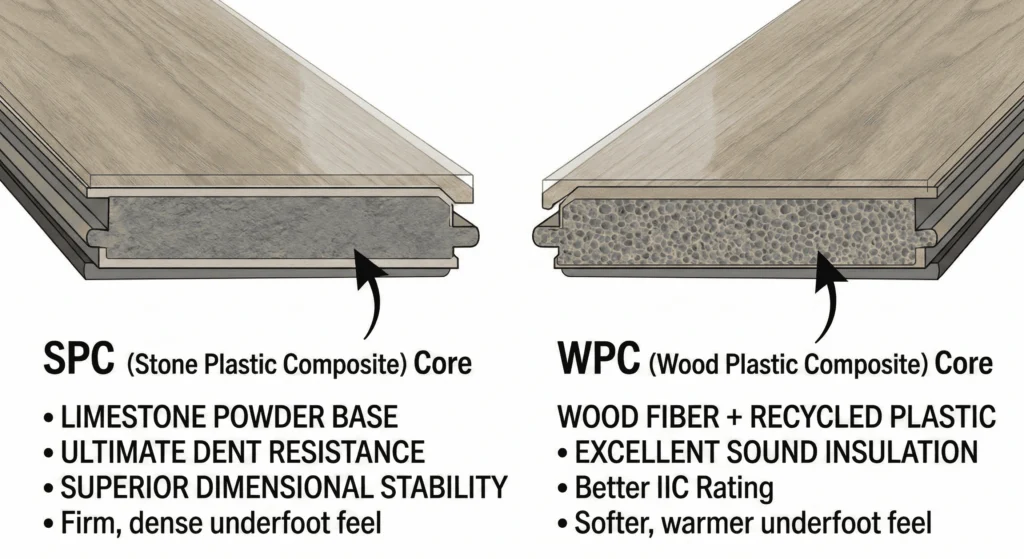
We get this question on most residential projects. The short version: SPC is denser and more dimensionally stable under temperature and load stress, WPC is softer underfoot and better at absorbing impact noise. Neither is universally better. The right answer depends on where the floor is going.
We have installed both in dozens of configurations over the years, and the installs that cause problems are rarely the ones where someone chose SPC over WPC or vice versa based on informed criteria. They are the ones where someone chose based on price or sample appearance alone, without accounting for the room conditions.
SPC vs WPC: Direct Comparison
| Feature | SPC (Stone Plastic Composite) | WPC (Wood Plastic Composite) |
| Composition | Limestone powder + PVC + stabilizers | Wood fiber + recycled plastic + foaming agents |
| Core Density | Very high (dense, rigid) | Lower (cellular, foam-infused) |
| Underfoot Feel | Firm, hard – similar to tile | Softer, warmer – closer to hardwood |
| Dent Resistance | Excellent – resists heavy furniture | Very Good – minor risk under concentrated loads |
| Dimensional Stability | Superior – resists temperature expansion | Good – slight movement in extremes |
| Sound Insulation (IIC) | Moderate – benefits most from underlayment | Superior – foam core absorbs impact noise |
| Typical Thickness | 3.5mm-6mm (thinner profile) | 5mm-8mm (slightly bulkier) |
| Best Environments | Below grade, kitchens, commercial, heavy pet traffic | Bedrooms, upper floors, condos (noise concerns) |
| Price Range | Budget to premium | Mid to premium |
Expert Decision Matrix: SPC vs WPC
Choose SPC if:
- You are installing in a basement, kitchen flooring area, or any zone where the subfloor is concrete or where moisture is a variable. SPC is more forgiving of minor vapor transmission than WPC, and its dimensional stability holds better in spaces where temperature swings through 20 to 30 degrees seasonally.
- You have large dogs or heavy furniture. We have seen WPC dent under refrigerator feet and under kennel crates over time. SPC holds up significantly better under sustained point loads.
- The installation is commercial or semi-commercial. SPC’s rigidity makes it more resistant to rolling load stress from office chairs, hand trucks, and carts.
- Temperature swings are significant. Garages, sunrooms, spaces near exterior doors. SPC expands and contracts less than WPC as the mercury moves.
Choose WPC if:
- Comfort matters above other considerations. Standing desks, playrooms, and kitchens where someone is on their feet for hours. The foam-infused core makes a real, noticeable difference after a long day. It is not dramatic, but it is real.
- You are in a multi-unit building, and IIC ratings are a compliance issue. WPC with a cork backing is the most practical path to achieving IIC 65 or higher without adding significant profile height.
- The space is a bedroom, home office, or bathroom flooring environment. Low-traffic rooms where dent resistance is secondary and warmth underfoot or noise reduction matters more.
- Cold-climate installations where radiant heat is not an option. The thermal resistance of WPC’s foam core provides marginal but measurable insulation, which some clients in older homes notice in winter.
Wear Layer Thickness: The Most Overlooked Factor in LVP Selection
This is the specification that determines how long the floor looks acceptable, not just how long it holds together structurally. We have pulled up floors after three years that were physically intact but visually finished because the wear layer had been abraded through in the high-traffic zones. The core was fine. The locking system was fine. The floor just looked destroyed.
Mil is thousandths of an inch, not millimeters. That distinction trips people up. A 20 mil wear layer is 0.02 inches of protective coating over the print. It sounds like nothing. Under foot traffic from shoes with grit tracked from outside, pet claws, and chair legs dragging across the surface day after day, the difference between 12 mil and 20 mil is years of usable life.
Wear Layer Thickness Guide: Matching Mil Rating to Use Case
| Wear Layer | Mil Thickness | Suitable For | Expected Lifespan | Warranty Tier |
| Entry Level | 6-8 mil | Rarely used guest rooms, low-traffic areas | 3-7 years under normal use | Limited / 5-year |
| Standard Residential | 12 mil | Average household without pets | 10-15 years | Lifetime residential (limited) |
| Family & Pet Grade | 20 mil | Households with pets, children, or frequent entertaining | 15-25+ years | Lifetime residential (full) |
| Commercial Grade | 28-30 mil | Retail, office, rental properties, commercial settings | 25+ years under heavy traffic | 10-15 year commercial |
From the field: The price gap between 12 mil and 20 mil products has compressed significantly. On a mid-size residential project we priced in early 2026, the difference was roughly $0.40 per square foot. Over 1,000 square feet that is $400 more to get a floor that should last twice as long. That math is not a close call.
One thing worth clarifying: the overall thickness of the plank and the wear layer thickness are not the same number. A 12mm thick LVP plank might have a 6 mil wear layer. The extra millimeters are the core and backing. We see this misunderstood constantly, both by homeowners and by some contractors who should know better. Always ask specifically about the wear layer. It is not implied by the total thickness.
2026 Eco-Innovation: PVC-Free & Low-VOC Flooring
We did not take indoor air quality seriously enough in the flooring specification five years ago. That has changed, partly because of better research and partly because of direct client feedback from households with infants, allergy sufferers, and people with chemical sensitivities. The questions we get now about off-gassing and VOC content would not have come up at all in 2019.
Traditional LVP is PVC-based. The phthalate plasticizer issue that generated controversy in the early 2010s has largely been addressed in reputable product lines, but that does not mean every product on the market is clean. Adhesives, UV coatings, and core stabilizers all contribute to the overall VOC profile of a newly installed floor, and in a sealed, new-construction space with limited ventilation, the first few weeks after installation matter more than most people account for.
Key Eco-Certifications to Require in 2026
| Certification | What It Tests | Why It Matters | Required For |
| FloorScore(R) | VOC emissions from resilient flooring | Independent verification of low-emission compliance | Schools, healthcare, LEED projects |
| GREENGUARD Gold | Evaluates environmental impact beyond just the use phase | Most stringent certification for occupied spaces | Homes with children or chemically sensitive occupants |
| Declare Label | Full ingredient transparency (Red List compliance) | Commercial/institutional specification | Architects, sustainability-focused projects |
| Cradle to Cradle | Full lifecycle: materials, water, energy, carbon | Evaluates environmental impact beyond just use phase | Evaluates environmental impact beyond just the use phase |
PVC-Free Alternatives: The Emerging Category
PVC-free options using polypropylene or PET-based cores are available and genuinely interesting, but they are not yet a mainstream product. We have specified them for a handful of clients with documented chemical sensitivities and the results have been good. The trade-off is cost and limited product selection. You are paying 15 to 30 percent more and working from a smaller design library.
Whether that trade-off is worth it depends entirely on the client and the space. For a primary bedroom in a household with a child who has respiratory sensitivities, the answer is probably yes. For a basement utility room, probably not. We expect this category to grow meaningfully by 2028 as manufacturing scale increases.
- For most households today, FloorScore and GREENGUARD Gold certified products are the most practical path to verified low-emission flooring without the cost premium of PVC-free lines.
- For anyone building or renovating with a long-term horizon, it is worth tracking the PVC-free category. The product quality is improving faster than the price is coming down, which usually means mainstream availability is a few years out.
We walk through certified product options on every project consultation and match them to the specific room environment and health priorities before any order is placed. If you want a pre-purchase review, our flooring services in New Jersey include material specification support as part of the initial consultation.
The 4 Best Luxury Vinyl Plank Flooring Brands in 2026
Brand matters more in LVP than in tile or hardwood for one practical reason: discontinued SKUs. We have had clients call three years after an installation needing replacement planks for a water-damaged section, and the product was no longer available. With smaller or newer brands, that happens. With the manufacturers below, the supply continuity is meaningfully more reliable.
We are not brand-agnostic on this. There are products we specify confidently and products we do not recommend, regardless of price. The four brands here represent what we have consistently been satisfied with in real-world installations over multiple years.
1. Shaw Floors – Best for Heavy-Duty Performance
Shaw is the largest flooring manufacturer in North America, which matters for supply chain reasons more than prestige. When a client needs matching replacement planks three years from now, Shaw is the most reliable bet for product continuity. The Floorte Pro line is where their durability engineering shows most clearly.
| Specification | Shaw Floors Detail |
| Wear Layer Range | Up to 30 mil on commercial-grade lines; 20 mil standard on residential Floorte Pro |
| Waterproof Rating | 100% waterproof – plank, core, and locking system |
| Pet Performance | Specifically tested and rated for large dogs (claws, accidents, repeated cleaning) |
| Warranty | Lifetime residential warranty on Floorte Pro; full replacement terms |
| Flagship Line | Floorte Pro Series – 5 Westbay, Premio Plus, Rainier |
| Best For | Households with large or multiple pets, basement installations, high-traffic commercial |
The pet-specific testing Shaw does on Floorte Pro is not marketing. We have had it hold up in homes with two large-breed dogs for five-plus years without visible wear layer compromise. That is a real data point. For households with serious pet traffic, Shaw is our first recommendation, not a hedge.
2. COREtec – Best for Premium Waterproof Design
COREtec invented WPC core technology. That is not a marketing claim; it is a patent history. The refinement advantage that comes from being first in a category is real, and their current lineup reflects it. The texture depth on COREtec’s embossed-in-register products is noticeably better than most competitors at equivalent price points.
| Specification | COREtec Detail |
| Core Technology | Original WPC pioneer; cork underlayment attached for superior sound control |
| Wear Layer Range | 20 mil standard; 30 mil on COREtec Pro Plus Enhanced lines |
| Aesthetic Range | Highest texture depth and realism in the WPC category; embossed-in-register printing |
| Sound Performance | Best-in-class for multi-story and condo applications due to cork backing |
| Waterproof Rating | 100% waterproof across all product lines |
| Best For | Design-forward buyers, condos, upper floors, noise-sensitive environments |
The cork backing is a genuine differentiator in condo and multi-unit contexts. We have specified COREtec in buildings where IIC requirements were a contractual condition, and the cork-backed products meet those thresholds without requiring additional underlayment in most configurations. That saves profile height, which matters at doorway transitions.
3. Mohawk Industries – Best for Value Plus Innovation
Mohawk is a thoughtful second choice on projects where Shaw or COREtec is over budget. The SolidTech line is not a compromise product. At 20 mil with the SPC core, it is a genuinely capable floor. The price advantage over premium brands tends to run 10 to 20 percent on comparable specifications, which, on a large residential project, is a meaningful number.
We are occasionally asked to compare Mohawk SolidTech against engineered hardwood flooring in the same project. Our typical guidance: if the installation is above grade, well-ventilated, and the client genuinely values natural wood character and the ability to refinish years down the road, engineered hardwood is the right answer. If there is any moisture uncertainty, a basement component, or the floor will be in a high-traffic zone, SolidTech is more practical and considerably more forgiving.
| Specification | Mohawk Industries Detail |
| Core Technology | SolidTech rigid core (SPC-based); proprietary stabilization formula |
| Locking System | UniClic Multifit – allows both angle-drop and fold-down installation |
| Wear Layer Range | 12-20 mil across residential SolidTech lines |
| Waterproof Rating | 100% waterproof – strong performance in kitchen and bath testing |
| Price Positioning | 10-20% below COREtec and Shaw at equivalent specifications |
| Best For | Large renovation projects, cost-performance optimization, DIY installation |
The UniClic locking system is worth mentioning specifically for contractors: the ability to switch between angle-drop and fold-down installation mid-floor is a real productivity benefit in rooms with irregular obstacles. Islands, structural columns, and doorframes that require approach angle changes. We have been using Mohawk on larger projects for exactly this reason.
4. Paramount Flooring – Best for Budget-Conscious Projects
Paramount is where we go when the budget is fixed, and the square footage is large. Rental unit renovations, secondary rooms in a multi-phase project, spaces where the floor needs to perform adequately for ten years rather than look exceptional for twenty. The product is honest. It does what it says.
| Specification | Paramount Flooring Detail |
| Wear Layer Range | 8-20 mil; specify 12 mil minimum for any occupied residential space |
| Price Range | Lowest cost-per-square-foot among named major brands |
| Design Range | Broad – covers warm tones, grays, and stone-look formats |
| Residential Durability | Reliable for standard household traffic without pets or heavy furniture loads |
| Best For | Rental units, large-scale budget renovations, secondary rooms |
| Limitation | Warranty terms shorter than Shaw or COREtec; fewer premium texture options |
The one discipline required with Paramount: verify the wear layer on the specific SKU. Their product range spans 8 mil to 20 mil, and it is not always obvious from the product name which tier you are looking at. We have seen 6 and 8-mil SKUs mixed into display racks alongside 12-mil products at similar price points. Ask directly, or read the spec sheet before ordering.
Installation Options: DIY or Professional?
The installation method is a structural decision, not an aesthetic one. The method you choose affects how the floor responds to subfloor movement, how it handles moisture from below, how easy it is to repair a damaged section, and whether it will comply with manufacturer warranty requirements. Getting it wrong does not always show up immediately. Sometimes it shows up two years later as edge lifting, joint separation, or buckling in a doorway.
Click-Lock (Floating Floor) – Most Common Method
Click-lock is the method we use for the majority of residential projects, and it is the most forgiving for DIY installers who are willing to do proper subfloor prep. The planks connect edge-to-edge without adhesive, and the floor moves as a unit above the subfloor. That movement is a feature, not a flaw. It accommodates the minor seasonal expansion and contraction that is normal in a conditioned space.
- Best for: Residential DIY, rental properties, any installation where the floor might need to be removed and reinstalled, or where subfloor access will eventually be needed for mechanical work.
- Limitations: Subfloor must be within 3/16 inch per 10 feet. We are strict about this. A floor that passes over a high or low spot will eventually develop a soft click underfoot, and that spot tends to become a stress point for the locking joint over time.
- Expansion gap: The perimeter gap of 1/4 inch around all fixed objects is not optional. We see this skipped on DIY jobs more often than anything else. Within 18 months, the floor has nowhere to go, and the middle starts to bow. It is a consistent, preventable failure.
- Sound: Floating floors transmit more impact noise than glued floors. In a single-family home, this is rarely an issue. In a condo or apartment, always verify IIC requirements before assuming the attached pad is sufficient.
Glue-Down Installation – Maximum Stability
Glue-down is what we specify when permanence matters more than flexibility. The floor is bonded directly to the subfloor, and there is no movement relative to the substrate. For large open-plan commercial spaces, spaces with radiant heat, or installations over 1,500 square feet where floating floor edge lift is a risk, glue-down is the right call. It is not a DIY-friendly method.
- Best for: commercial flooring services environments, retail spaces, radiant heat systems, and large residential open plans where floating floor movement at the perimeter would be unacceptable.
- Limitations: Subfloor tolerance tightens to 1/8 inch per 6 feet. Adhesive selection must match the core type. Use the wrong adhesive, and you may get a chemical interaction that off-gasses or degrades the backing over time. It happens.
- Repair consideration: Replacing a single damaged plank in a glue-down installation is a full day’s work. You are cutting adhesive, lifting surrounding planks carefully, and re-bonding with matched material. Plan for this when specifying glue-down in spaces that see significant dropped-object risk.
- Moisture testing: Non-negotiable on concrete subfloors. We use in-situ RH probe testing per ASTM F2170. Failed adhesive bond from vapor transmission is the leading cause of glue-down LVP claims, and it is entirely preventable with a two-hour test before installation begins.
Loose Lay Installation – Speed and Flexibility
Loose lay has a narrow use case, but within that use case, it is genuinely useful. Phased renovation projects where you want a functional floor temporarily, spaces that get reconfigured seasonally, or any installation where the client wants the ability to lift and relay the floor without damage. We do not use it as a permanent solution in occupied residential spaces.
- Best for: Temporary or phased installations, spaces undergoing active renovation, and any area where subfloor access is a recurring need.
- Limitations: Not suitable for spaces with frequent heavy furniture movement or significant humidity swings. Without any mechanical bond, edge lift is a real risk in rooms with wide temperature differentials.
- Room size cap: Most manufacturers specify loose lay-up to 50 feet in any direction. Beyond that, edge lift becomes likely over time regardless of how dense the backing is.
From the field: Click-lock is DIY-viable for anyone with basic carpentry skills and the patience to do subfloor prep correctly. The prep is where we see amateur installs go wrong. Not the clicking together of planks – that part is genuinely easy. The leveling, the moisture check, and the perimeter gap discipline are where the floor either succeeds or fails long-term.
3 Costly Mistakes Homeowners Make When Buying LVP
We have corrected a lot of flooring mistakes over the years. Most of them were not caused by bad luck or defective products. They were caused by the same three errors, repeated across different clients, different products, and different room types. We have seen all three in houses that were a year old and in renovations that were supposed to last twenty years.
Mistake 1: Ignoring Subfloor Leveling
Rigid core LVP does not conform to the subfloor. It bridges over low spots and rocks on high spots. In the first few weeks after installation, neither issue is necessarily visible. Six months later, the high spots have created locking joint stress, and the low spots have created a hollow-sounding flex that every visitor notices when they walk across the room.
The tolerance numbers are real minimums, not conservative estimates. 3/16 inch per 10 feet for floating floor installation. 1/8 inch per 6 feet for glue-down. We measure with a long straightedge on every project before pulling out any flooring product, and we find out-of-tolerance subfloors on roughly a third of the jobs we walk into cold.
- Self-leveling compound addresses most low spots in concrete subfloors at modest material cost. The constraint is cure time, usually 24 hours minimum before foot traffic and 48 hours before flooring installation. Rushing this step is what causes leveling compound failures. For existing wood subfloors with deeper structural problems, professional floor refinishing and subfloor restoration services can address rot, delamination, or historical damage before any new product goes down.
- High spots in wood subfloors need to be sanded or ground down. This is not glamorous work, but it is not optional. We apply the same subfloor tolerance standards to LVP that apply to tile flooring installation. Both are rigid surface products that will telegraph subfloor imperfections into the finished floor. The physics are the same.
Mistake 2: Choosing Based on Price Per Square Foot Alone
A 6 mil wear layer and a 20 mil wear layer look identical in the box and nearly identical on the sample board. They do not perform identically. In a household with a dog, kids, and shoes coming in from outside, the 6 mil product will be visibly scratched in the primary traffic zones within 18 months. The 20 mil product will look like it did on installation day.
We ask clients to think about flooring cost per year of useful life, not cost per square foot at the point of purchase. A $1.40 per square foot floor that needs replacing in five years costs $0.28 per square foot per year. A $2.80 per square foot floor that lasts 20 years costs $0.14 per square foot per year and includes no reinstallation labor in that calculation. The arithmetic is not subtle.
Mistake 3: Skipping Appropriate Underlayment
Most LVP products come with an attached pad. Most of the time, for most residential installations, that pad is adequate. But there are three specific conditions where relying solely on the attached pad is a risk worth addressing with supplemental underlayment:
- Concrete subfloors below grade: Ground-contact concrete transmits vapor even when it tests dry on a given day. Seasons change, water table shifts, and the vapor pressure changes with it. A 6-mil polyethylene barrier between the slab and the floor adds meaningful long-term protection against what is an unpredictable variable.
- Multi-story wood subfloors: The IIC rating of most attached pads is insufficient for multi-family building acoustic requirements. If the building has noise covenants or the tenant below has ever complained, budget for a supplemental underlayment rated at IIC 65 or higher.
- Radiant heat systems: Standard foam underlayments insulate against the heat transfer that the radiant system is designed to deliver. Use only underlayments rated specifically for radiant heat compatibility. Thinner IXPE or cork-based products are the right specification here. We have seen standard foam underlayments half as effective as a radiant system in a room that costs significant money to heat.
Is LVP Really Waterproof? The Complete Answer
The short answer is yes, within a specific and important set of boundaries. The plank itself will not swell, delaminate, or warp when water sits on it. We have tested this directly with SPC and WPC products from multiple manufacturers, and the planks hold up. The locking joints on quality products seal well enough to prevent water from migrating through at a normal rate.
Where the waterproof claim breaks down is when people extend it to mean the entire flooring system is waterproof. It is not. The subfloor is not waterproof. The adhesive on a glue-down installation is not immune to sustained vapor transmission from below. And if water gets under a floating floor and cannot evaporate because the floor above is blocking ventilation, you may not have a damaged floor, but you may have a damaged subfloor and a mold issue that presents six months later.
| Component | Waterproof? | Risk Without Precautions | Mitigation |
| LVP Planks | Yes – PVC/SPC/WPC core | Planks themselves will not fail | None required at the plank level. |
| Locking Joints | Yes on quality products | Lower-quality lock systems may allow seam infiltration | Use brands with tested waterproof lock systems |
| Attached Underlayment | Varies by product | Verify pad material; use a vapor barrier on concrete | 6-mil poly vapor barrier; address the source of moisture |
| Wood Subfloor | No | Prolonged moisture causes rot, mold, and structural failure | 6-mil poly vapor barrier; address source of moisture |
| Concrete Subfloor | Resists but not impermeable | Vapor transmission causes adhesive failure and mold | RH probe test; apply moisture mitigation before installation |
We specify LVP confidently in kitchens, mudrooms, bathrooms, and basements, and we have done so for years. The key is handling moisture management at the subfloor level before installation, not after something goes wrong. Browse the full range of waterproof vinyl plank flooring options if you want to compare core specifications and moisture ratings side by side before making a final decision.
Final LVP Buying Checklist
This is the list we work through on every project before placing a flooring order. Each item represents something we have seen go wrong when it was skipped. None of it is complicated. All of it matters.
- DONE Wear layer is 12 mil minimum; 20 mil for any household with pets, children, or above-average traffic.
- DONE Core type matched to the environment: SPC for below-grade, concrete, or high-moisture areas; WPC for upper floors, condos, or comfort-priority spaces.
- DONE Product carries FloorScore(R) or GREENGUARD Gold certification. If the product sheet does not list it, ask specifically before ordering.
- DONE Warranty terms confirmed in writing: lifetime residential versus limited, full replacement versus pro-rated coverage. These are materially different outcomes when a claim happens.
- DONE Subfloor measured and documented: 3/16 inch per 10 feet for floating, 1/8 inch per 6 feet for glue-down. Out-of-tolerance areas addressed before product delivery.
- DONE Moisture testing completed on concrete subfloors using in-situ RH probe per ASTM F2170, or calcium chloride test per ASTM F1869. Document the results. Most manufacturer warranties require it.
Final Verdict: Is Luxury Vinyl Plank Worth It in 2026?
Yes, with the same qualification we would apply to any durable goods purchase: only if the specification matches the use case. We have seen LVP succeed in spaces where tile would have been the default choice and where engineered hardwood would have struggled with the moisture conditions. We have also seen it fail in spaces where the wrong core was chosen, the subfloor was not addressed, and the wear layer was too thin for the actual traffic.
The category is genuinely mature at this point. The R&D investment from the major manufacturers over the past decade has produced products that hold up, look convincing, and carry warranty terms that reflect real confidence in the material. The 20 mil SPC core segment in particular represents excellent value for the performance delivered.
| If Your Priority Is… | Best LVP Choice | Specification to Require |
| Maximum durability | Shaw Floorte Pro (30 mil) | SPC core, 28-30 mil wear layer, waterproof lock |
| Acoustic comfort | COREtec Plus (cork backing) | WPC core, cork underlayment, IIC 65+ |
| Design realism | COREtec Pro Enhanced | Embossed-in-register texture, matte finish |
| Budget optimization | Mohawk SolidTech | SPC core, 20 mil wear layer, UniClic system |
| Eco-consciousness | FloorScore/GREENGUARD Gold certified product | Low-VOC; PVC-free if budget allows |
| Large-scale value | Paramount (12-20 mil tier) | Verify wear layer per SKU; avoid 6-8 mil lines |
The perfect floor for your home exists within this category—the secret is knowing exactly what to ask for before the purchase, not after the installation. At J Brothers Flooring, our reputation is built on this precision, reflected in the 5-star reviews from our local clients who value our transparent, expert-led approach. If you want the same peace of mind for your project, [read our client success stories and reviews here] to see why we are the trusted choice for luxury vinyl plank (LVP) in the community.
Frequently Asked Questions
How do I clean luxury vinyl plank flooring properly?
Regular sweeping with a microfiber dust mop handles daily maintenance on most LVP products. For deeper cleaning, a damp mop with a pH-neutral vinyl-specific cleaner is sufficient. Avoid steam mops — the sustained heat and moisture forced through seams can compromise locking joints and degrade the backing adhesive on glue-down installations over time. We have seen steam mop damage on floors that were otherwise in excellent condition.
How do I accurately calculate how much LVP to order?
Measure each room in feet, multiply length by width for square footage, then add a waste factor. Ten percent is standard for rectangular rooms with straightforward layouts. Go to 15 percent for rooms with angles, alcoves, or diagonal installation patterns. Order full boxes from the same production run where possible. Dye-lot variation between runs is real in printed vinyl products, and reorder matching is not guaranteed, particularly with smaller brands.
What is the real difference between SPC and WPC in daily use?
SPC feels firmer underfoot, closer to tile. WPC feels slightly softer and warmer, closer to hardwood. The structural difference is the core composition: limestone-based for SPC, foam-infused wood fiber for WPC. For daily use, the relevant trade-offs are: SPC holds up better under heavy loads and in variable-temperature environments; WPC absorbs impact noise better and is more comfortable for long periods of standing. Both are 100 percent waterproof at the plank level.
Is luxury vinyl plank flooring a good choice for kitchens and bathrooms?
It is one of the most practical choices for both, assuming the core and subfloor conditions are handled correctly. The plank itself handles spills, splashes, and cleaning chemistry without issue. The risk is at the subfloor level, not the product level. In kitchens and bathrooms, we always address concrete vapor transmission before installation and verify that the locking system on the chosen product is specifically rated as waterproof, not just water-resistant.
Can luxury vinyl plank be installed over an existing floor?
In most cases, yes, if the existing surface is structurally sound, clean, and within the levelness tolerance for the chosen installation method. LVP can float over existing tile, vinyl sheet, or hardwood. It cannot go over soft materials like carpet, cork, or foam-backed sheet vinyl that compress underfoot. Always verify that the combined floor height does not create transition problems at doorways or conflict with appliance clearances. That is a detail that gets missed more often than it should.