Bound Brook sits in the Raritan River floodplain, and that single fact should shape every flooring decision made in this borough. Homes here have flooded — some repeatedly — and many have basements and ground floors that have been rebuilt more than once. Luxury vinyl plank is the most sensible flooring choice in this town for reasons that have nothing to do with fashion.
This guide covers what to look for in LVP specifically for Bound Brook conditions, what it costs installed, and the installation details that matter in a flood-risk area.
Why Vinyl Plank Suits Bound Brook Homes
LVP has a plastic core. Where laminate swells permanently and hardwood cups and stains, vinyl plank can be exposed to water and survive it. In a borough with the Raritan’s flood history, that is not a marginal advantage.
Two honest caveats, because no one selling you a floor should skip them:
- Waterproof planks do not make a waterproof floor. Water travels beneath the flooring and into the subfloor, and after any significant flooding the subfloor must be assessed and dried regardless of what is on top of it.
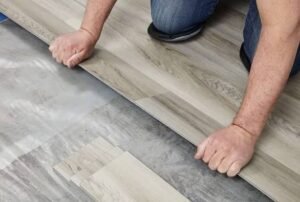
- Glue-down installations resist water intrusion at the seams better than floating floors, and are usually the better specification in a flood-risk property even though they cost slightly more to install.
What to Look for in LVP Here
| Specification | What to choose | Why it matters in Bound Brook |
|---|---|---|
| Core type | SPC (stone plastic composite) | More dimensionally stable in humidity swings than WPC |
| Wear layer | 12 mil minimum, 20 mil for main floors | Determines how long the surface survives traffic |
| Installation method | Glue-down in ground floors and basements | Resists water working into seams |
| Thickness | 5mm or greater | Better feel underfoot and bridges minor subfloor variation |
| Attached underlayment | Useful, but never add a second layer | Doubling up voids most warranties |
| Moisture barrier | Required over any slab | Slab moisture is constant here, flood or no flood |
Our complete LVP buying guide goes into core types, wear layers and brand differences in more detail.
What It Costs
Luxury vinyl plank in New Jersey runs $5 to $11 per square foot installed, covering material, labour and standard preparation. Where a Bound Brook project sits in that range depends mostly on two things: whether the subfloor needs work after previous water exposure, and whether you specify glue-down rather than floating.
- Material only: $1.50 to $7.00 per sq ft depending on tier and wear layer
- Removal and disposal of the existing floor: $1 to $3 per sq ft
- Subfloor levelling or repair: $1.50 to $8 per sq ft where needed
- Glue-down premium over floating: modest, and usually worth it here
Our NJ flooring installation cost guide breaks down every line item that should appear on a quote.
Installation Details That Matter in a Flood-Risk Property
- Test the subfloor for moisture before anything goes down. Slabs in this area frequently read high. Installing over a wet slab guarantees a failure regardless of the product.
- Address the cause of past water first. Grading, gutters, sump pump condition and foundation sealing all sit upstream of the flooring decision.
- Leave the correct expansion gap. Vinyl expands and contracts with temperature. A floating floor pinned tight at the walls will buckle.
- Consider where transitions fall. In a property that may flood again, having transitions at room boundaries makes partial replacement far simpler than one continuous floor throughout.
- Keep a spare box. Colours are discontinued constantly. A box in the basement — ideally raised off the floor — is what makes a repair possible in three years.
Alternatives Worth Considering
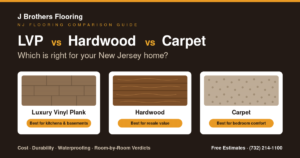
LVP is not the only sensible answer. Porcelain tile is completely impervious and will survive flooding better than anything else, at the cost of comfort and price. Engineered hardwood is a reasonable choice on upper floors that are not at flood risk, where the look of real wood matters. What we would not generally recommend on a ground floor in this borough is laminate or solid hardwood.
Frequently Asked Questions
Is vinyl plank flooring really waterproof?
The planks are — the core will not swell or delaminate. The floor as a system is not, because water can reach the subfloor through seams and edges. After any flooding event, the subfloor needs assessment and drying even if the vinyl looks fine.
Should I choose floating or glue-down vinyl plank in Bound Brook?
Glue-down for ground floors and basements. It resists water working into the seams and is more stable over a slab. Floating installation is fine on upper floors and costs slightly less.
What wear layer do I need?
12 mil is adequate for bedrooms and low-traffic rooms. 20 mil is the sensible choice for kitchens, hallways, entryways and any home with pets or children. Paying for 30 mil in a guest bedroom is money spent where it will never be tested.
Can vinyl plank be installed over an existing floor?
Sometimes, over sound vinyl or tile that is flat and well-bonded. It is rarely a good idea over any floor that has previously been wet, because whatever is underneath cannot be inspected or dried. In a flood-risk property, taking the old floor up is usually the right call.
How long does vinyl plank last?
Fifteen to twenty-five years with a good wear layer and normal use. In a property that floods, the limiting factor is generally the subfloor rather than the vinyl.
Local Installation
We install luxury vinyl plank throughout Bound Brook and the surrounding Somerset and Middlesex County towns, and we will tell you honestly what your subfloor needs before we quote the floor. Contact J Brothers Flooring for a free measurement, or see our Bound Brook flooring services and full LVP installation options.